

Custom CNC Aluminum Parts for Precision OEM Manufacturing
Guo Di Aluminum manufactures custom CNC machined aluminum parts for OEM manufacturers, engineering companies, equipment builders, and industrial buyers.
From simple brackets and housings to complex precision components, we produce aluminum parts according to your 2D drawings, 3D CAD files, samples, and technical specifications.
Our capabilities cover CNC milling, CNC turning, drilling, tapping, multi-axis machining, aluminum extrusion, and surface finishing, allowing customers to source machined aluminum components through an integrated manufacturing process.
Whether you need a few prototypes for design validation or repeat production for an established product, our engineering team can review your design, recommend a suitable machining strategy, and support the project from DFM analysis through final inspection and delivery.
Send your CAD file or drawing to receive a CNC machining review and quotation.

Custom CNC Machined Aluminum Parts
CNC machining is a flexible manufacturing method for producing aluminum components with complex geometries, functional surfaces, holes, threads, pockets, slots, and other precision features.

At Guo Di Aluminum, CNC-machined aluminum parts can be produced as:
- Fully machined components
- Machined parts from aluminum bar or plate
- Secondary-machined aluminum extrusions
- CNC-machined housings
- Precision mechanical components
- Structural aluminum components
- OEM replacement parts
- Prototype components
- Production parts
Our manufacturing approach is particularly suitable for customers who require more than a standard machining supplier.
By combining aluminum extrusion and CNC machining, we can evaluate whether a component is better produced entirely by CNC machining or manufactured from a custom aluminum extrusion followed by CNC processing.
This can be especially valuable for components with a repeated cross-section, where extrusion can create the basic geometry before machining only the features that require precision.
CNC Aluminum Machining Capabilities
Guo Di Aluminum provides multiple machining processes to accommodate different component geometries and production requirements.

CNC Milling
CNC milling is suitable for aluminum components requiring:
- Flat surfaces
- Pockets
- Slots
- Contours
- Holes
- Cut-outs
- Mounting features
- Complex 3D geometries
The current Guo Di CNC machining capability includes 3-axis, 4-axis, and full 5-axis CNC milling.
Multi-axis machining can reduce the number of setups required for certain complex components and help improve consistency between multiple machined features.
CNC Turning
CNC turning is suitable for rotational aluminum components such as:
- Shafts
- Bushings
- Pins
- Rings
- Cylindrical housings
- Threaded components
For parts combining turning and milling requirements, mill-turn machining can also be considered where appropriate.


Drilling and Tapping
Precision drilling and tapping can create reliable connection points for:
- Bolts
- Screws
- Fasteners
- Assembly components
- Threaded inserts
Hole position, diameter, depth, and thread specification can be controlled according to the customer’s engineering drawing.
Common thread requirements may include metric, UNC, and UNF specifications.
Multi-Axis CNC Machining
Complex aluminum components may require machining from multiple directions.
Multi-axis CNC machining can help manufacture:
- Angled surfaces
- Complex contours
- Multiple faces
- Deep features
- Detailed mechanical components
The appropriate machine configuration depends on part geometry, tolerances, machining volume, and production quantity.

CNC Machined Aluminum Parts Specifications
Every CNC project is manufactured according to its own technical requirements.
Typical specifications include:
| Parameter | Capability / Options |
|---|---|
| Materials | 6061, 6063, 6082, 7075 and other suitable alloys |
| Machining | Milling, turning, drilling, tapping, multi-axis machining |
| Standard Tolerance | Approximately ±0.05 mm |
| Higher Precision | Up to approximately ±0.01 mm where technically achievable |
| Surface Roughness | Typical Ra 1.6–3.2, with finer finishes available |
| Threads | Metric, UNC, UNF and custom specifications |
| Part Size | Based on part geometry; machining capability up to approximately 1300 mm |
| Surface Finishing | Anodizing, powder coating, brushing, polishing, sandblasting and other options |
| Production | Prototype, low-volume and production manufacturing |
| File Formats | STEP, IGS, PDF, DWG and other commonly used CAD formats |
Actual tolerances depend on factors such as part dimensions, geometry, material, machining process, feature location, and drawing requirements.
Critical dimensions should always be clearly identified on the engineering drawing.
Guo Di’s existing CNC machining information specifies a standard tolerance of approximately ±0.05 mm, with tighter tolerances available depending on the project.
Aluminum Materials for CNC Machining
Material selection affects machinability, strength, corrosion resistance, weight, surface appearance, and final application performance.
Guo Di Aluminum works with several commonly used aluminum alloys.

6061 Aluminum CNC Parts
6061 aluminum is one of the most widely used choices for CNC-machined components.
It provides a practical balance of:
- Strength
- Machinability
- Corrosion resistance
- Weight
- Cost
6061 can be suitable for:
- Brackets
- Housings
- Machine components
- Structural parts
- Fixtures
- General industrial components
6063 Aluminum CNC Parts
6063 aluminum is known for its excellent extrusion characteristics and attractive surface quality.
It is particularly relevant when CNC machining is combined with aluminum extrusion.
Potential applications include:
- Extruded housings
- Decorative components
- Frames
- Profiles
- Components requiring anodizing


6082 Aluminum CNC Parts
6082 aluminum is commonly used in European industrial applications where higher mechanical strength is required.
It can be considered for:
- Load-bearing components
- Industrial machinery
- Mechanical parts
- Structural components
- Transportation equipment
7075 Aluminum CNC Parts
7075 aluminum is a high-strength aluminum alloy used when strength-to-weight performance is a major consideration.
Potential applications include:
- High-performance mechanical components
- Aerospace-related components
- Automotive components
- Precision fixtures
- High-strength parts

The correct material should be selected according to the actual operating requirements rather than simply choosing the strongest available alloy.
CNC Machined Aluminum Parts from Extrusions
One of Guo Di Aluminum’s important manufacturing advantages is the ability to combine aluminum extrusion with CNC machining.
This can be advantageous for parts with a consistent longitudinal cross-section.
Instead of machining the entire component from a solid block, a custom extrusion can create much of the basic geometry.

CNC machining can then be used for:
- Holes
- Slots
- Pockets
- End features
- Mounting surfaces
- Threads
- Cut-outs
- Precision interfaces
This approach can potentially reduce machining time and material waste for suitable production designs.
For OEM projects with recurring production volumes, our engineers can compare different manufacturing approaches and help determine whether CNC machining, extrusion + CNC machining, or another process is more appropriate.
CNC Aluminum Parts for OEM Applications
Guo Di Aluminum supports OEM customers who require repeatable aluminum components rather than one-time prototype machining.
Typical OEM applications include:
Industrial Machinery
- Machine components
- Mounting brackets
- Structural parts
- Mechanical housings
- Fixtures
Automation Equipment
- Robot components
- Automation frames
- Mounting plates
- Motion-system components
- Custom brackets
Electronics
- Aluminum housings
- Heat dissipation components
- Mounting structures
- Equipment frames
Automotive and Transportation
- Precision mechanical components
- Structural parts
- Brackets
- Fixtures
- Lightweight components
Medical and Laboratory Equipment
For suitable non-sterile applications, CNC-machined aluminum may be used for equipment structures, housings, fixtures, and mechanical components.
Consumer and Commercial Products
- Product housings
- Furniture hardware
- Display systems
- Premium components
- Commercial equipment
The final material and manufacturing process should always be selected according to the specific application and applicable industry requirements.
CNC Aluminum Parts Design for Manufacturability
A good CNC part is not only designed to function correctly; it should also be practical to manufacture.
Our engineering team can review your design before production and identify opportunities to improve machining efficiency, dimensional stability, and production cost.
Avoid Unnecessarily Deep Cavities
Deep pockets require longer cutting tools, which can increase vibration and reduce machining efficiency.
Where possible, cavity depth should be balanced with tool diameter and the required component geometry.
Consider Internal Corner Radii
CNC milling tools are generally cylindrical, so internal corners naturally require a radius.
Designing realistic internal radii can avoid unnecessary special tooling and reduce machining difficulty.
Control Thin Walls
Very thin aluminum walls can be more susceptible to:
- Vibration
- Deflection
- Deformation
- Machining instability
Wall thickness should therefore be considered together with part height, geometry, material, and machining method.
Guo Di’s current CNC design guidance specifically recommends avoiding excessively thin walls and notes that machining depth, internal corners, and feature geometry can affect cost and manufacturability.
Use Tight Tolerances Only Where Necessary
Not every dimension needs the same tolerance.
Applying tight tolerances only to functional dimensions can help reduce:
- Machining time
- Inspection requirements
- Tool wear
- Production cost
For example, a precision bearing seat may require a tighter tolerance than a non-functional external surface.
Aluminum CNC Machining Tolerances
Tolerance requirements should be determined by the function of the component.
Guo Di Aluminum can manufacture CNC-machined aluminum parts according to customer drawings and specified dimensional requirements.
Typical machining information includes:
- Standard tolerances around ±0.05 mm
- Tighter tolerances available for suitable features
- Hole diameter control
- Thread specifications
- Dimensional inspection
- Geometric inspection where required
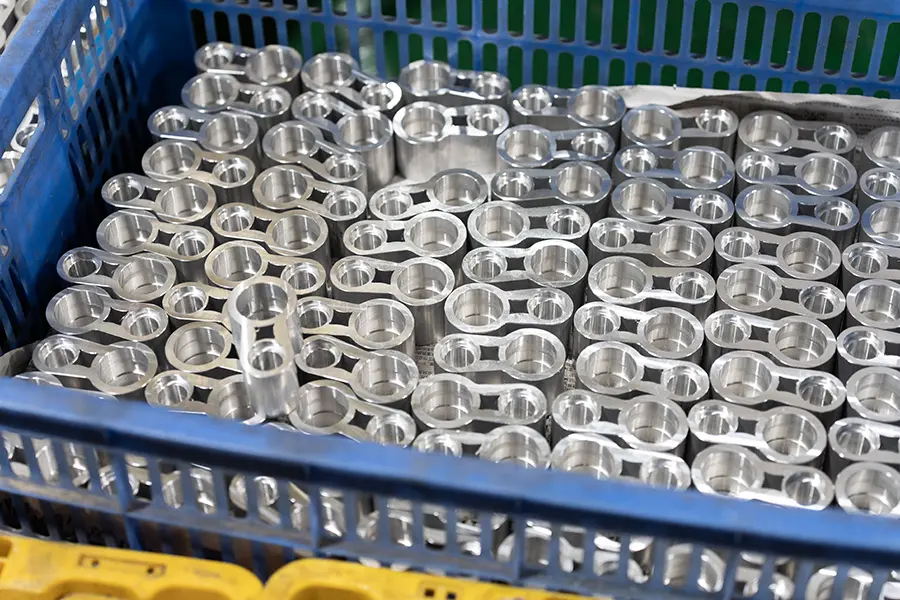

For particularly critical components, the drawing should clearly identify:
- Critical dimensions
- Datum references
- Geometric tolerances
- Surface roughness
- Thread requirements
- Inspection requirements
Our engineering team can review the drawing before production to determine whether the requested tolerances are appropriate for the selected manufacturing process.
Surface Finishing for CNC Aluminum Parts
Machining is only one part of the finished component.
Depending on the product requirements, CNC aluminum parts can receive additional surface treatment.
Anodizing
Anodizing can improve surface appearance and provide a protective oxide layer.
It is commonly considered for aluminum components requiring a durable metallic appearance.
Powder Coating
Powder coating provides a wide selection of colors and surface textures.
It can be suitable for equipment housings, frames, commercial products, and other components where appearance and surface protection are important.
Brushed Finish
Brushing creates a directional linear texture and can provide a modern industrial appearance.
Polishing
Polishing can produce a smoother and more reflective aluminum surface for appearance-focused components.
Sandblasting
Sandblasting can create a uniform matte or textured surface and may also be used as part of a preparation process before further finishing.

Guo Di’s current CNC parts page lists anodizing, powder coating, brushing, polishing, and sandblasting among its available surface finishing options.
Quality Control for CNC Machined Aluminum Parts

Precision manufacturing requires more than accurate machining equipment.
Quality control should begin with the customer’s drawing and continue throughout production.
Depending on project requirements, inspection can include:
- Raw material verification
- Dimensional inspection
- Hole diameter inspection
- Hole position inspection
- Thread inspection
- Surface roughness inspection
- Profile and geometry inspection
- Critical feature inspection
- Surface finish inspection
- Final visual inspection
For critical OEM components, inspection criteria can be established around the approved engineering drawing.
Guo Di’s CNC machining service states that critical dimensions, surface quality, and mechanical performance are checked to ensure compliance with specifications.
Prototype and Low-Volume CNC Aluminum Parts
CNC machining is particularly useful during the product development stage because the same basic manufacturing method can be used to create functional prototypes before larger-scale production.
Guo Di Aluminum supports projects from prototype development through production manufacturing.
A typical development project may involve:
CAD Design
↓
DFM Review
↓
Prototype Machining
↓
Dimensional Inspection
↓
Design Modification
↓
Production Approval
↓
Repeat Manufacturing

This workflow allows engineers to identify design issues before committing to larger production quantities.
For customers developing a new product, prototype machining can therefore be used to validate:
- Physical dimensions
- Assembly
- Fit
- Functional interfaces
- Surface finish
- Machining feasibility
Why Choose Guo Di Aluminum for CNC Machined Parts?
Choosing a CNC supplier is not simply a matter of comparing hourly machining prices.
For OEM buyers, the supplier’s ability to coordinate engineering, material, machining, finishing, inspection, and delivery can be equally important.
Guo Di Aluminum combines:
✅️ 20+ Years of Manufacturing Experience
The company identifies more than 20 years of experience in custom aluminum processing.
✅️ 30 CNC Machines
A larger machine base supports different machining requirements and production scheduling.
✅️ 3-, 4- and 5-Axis CNC Milling
Multiple milling configurations are available for different part geometries.
✅️ Aluminum Extrusion + CNC
Custom extrusions can be combined with CNC machining for suitable component designs.
✅️ Multiple Surface Finishes
Anodizing, powder coating, brushing, polishing, sandblasting, and other finishing options can be coordinated with CNC production.
✅️ Prototype to Production
Projects can be supported from initial prototype development through repeat production.
✅️ Engineering Support
DFM feedback can be provided to help identify potential manufacturing issues before production.
Frequently Asked Questions About CNC Machined Aluminum Parts
What are CNC machined aluminum parts?
CNC machined aluminum parts are components manufactured from aluminum using computer-controlled machining equipment.
The process can produce precise holes, slots, pockets, contours, threads, and complex geometries according to a digital design or engineering drawing.
What aluminum alloys can you CNC machine?
Common options include 6061, 6063, 6082, and 7075.
The appropriate alloy depends on strength, machinability, corrosion resistance, weight, surface finish, and application requirements.
What CNC machining processes do you offer?
Guo Di Aluminum provides CNC milling, CNC turning, drilling, tapping, and multi-axis machining.
The company currently lists 3-, 4-, and full 5-axis CNC milling capabilities.
What tolerance can you achieve on CNC aluminum parts?
Standard machining tolerance is approximately ±0.05 mm, while tighter tolerances can be considered for suitable parts and features.
The achievable tolerance depends on geometry, size, material, machining method, and inspection requirements.
Can you machine aluminum extrusion profiles?
Yes.
Extruded aluminum profiles can be CNC machined to add holes, slots, pockets, threads, mounting surfaces, and other precision features.
Can you manufacture prototypes?
Yes. CNC machining is suitable for prototype and low-volume production because parts can be produced directly from CAD data without creating complex molding systems.
Can you produce high-volume CNC aluminum parts?
Yes. Production quantity can be discussed according to part complexity, machining cycle time, material, tolerances, and required delivery schedule.
For suitable designs, extrusion combined with CNC machining may provide an alternative production route for larger recurring volumes.
What CAD files do you accept?
Common formats include STEP, IGS, PDF, and DWG.
A 3D CAD file together with a 2D technical drawing is recommended for precision parts.
Can CNC aluminum parts be anodized?
Yes. Anodizing can be combined with CNC machining to provide a protective and decorative aluminum surface.
Can CNC parts be powder coated?
Yes. Powder coating is available for applications requiring customized colors and a durable surface coating.
Do you offer brushed and polished aluminum finishes?
Yes. Brushed and polished finishes can be considered depending on the component geometry and appearance requirements.
Can you machine threaded holes?
Yes. CNC machining can produce internal and external threaded features according to the specified thread standard.
Metric, UNC, UNF, and custom thread requirements can be evaluated.
What information do you need for a CNC machining quotation?
For the most accurate quotation, send:
- 3D CAD file
- 2D technical drawing
- Material
- Quantity
- Required tolerance
- Surface finish
- Thread specifications
- Inspection requirements
- Packaging requirements
The more complete the information, the more accurately the manufacturing process and quotation can be evaluated.
Request a Quote for CNC Machined Aluminum Parts
Looking for a reliable CNC machined aluminum parts manufacturer for your next OEM project?
Guo Di Aluminum can support your project with:
CNC Milling + CNC Turning + Drilling & Tapping + Aluminum Extrusion + Surface Finishing + Quality Inspection
Whether you need a single prototype, a small production run, or recurring OEM manufacturing, send your design files to our engineering team.
We can review your:
- Part geometry
- Aluminum alloy
- Machining requirements
- Tolerances
- Surface finish
- Production quantity
- Packaging requirements
Start Your CNC Aluminum Parts Project
Upload your CAD file and request a manufacturing review and quotation.
Email: guodialuminum@gmail.com
WhatsApp / Phone: +86 13726646179
About Guo Di Aluminum

Guo Di Aluminum is a China-based manufacturer specializing in custom aluminum extrusion and CNC-machined aluminum components.
The company provides integrated manufacturing services including:
Aluminum Extrusion | CNC Machining | Punching | Welding | Surface Treatment
With more than 20 years of experience, 30 CNC machines, 12 aluminum extrusion lines, and an integrated production model, Guo Di Aluminum supports customers from prototype development to production manufacturing.
For OEM buyers looking for a supplier capable of combining custom extrusion, precision machining, finishing, inspection, and delivery, Guo Di Aluminum provides a single manufacturing partner for the complete aluminum component workflow.
Send your CAD file today and let our engineering team review your CNC aluminum part.